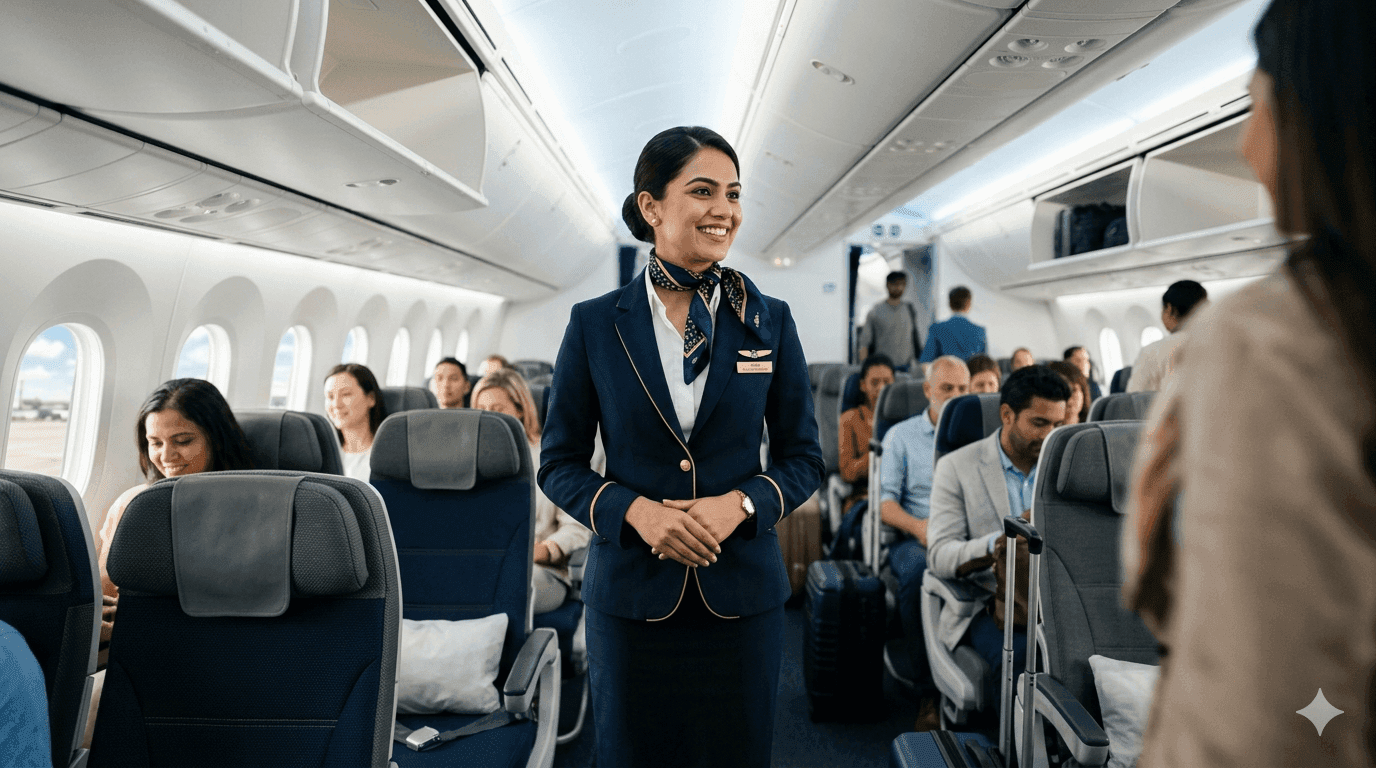

The cabin crew profession — also known as air hostess or flight attendant in everyday language — is one of the most visible and safety-critical roles in commercial aviation. While often perceived as a hospitality career, cabin crew are first and foremost aviation safety professionals — trained to handle emergencies, manage evacuations, administer first aid, and ensure every passenger reaches their destination safely.
India's rapidly expanding aviation sector — with new airlines, new routes, and a growing middle-class passenger base — has created strong and sustained demand for trained cabin crew professionals. Whether you are a fresh graduate exploring aviation careers or someone looking for a dynamic and travel-rich work life, a cabin crew career offers both purpose and opportunity.
This guide covers everything you need to know: the role, eligibility, training, skills, career growth, and how to take the first step.
Need personalised guidance on cabin crew careers?
Book a free career consultation with our aviation experts before you apply.
1. Role of Cabin Crew in Aviation
Cabin crew members are the primary safety professionals onboard a commercial aircraft. Their responsibilities begin before the first passenger boards and continue until the aircraft is cleared after landing. In-flight service — meals, beverages, comfort — is secondary to their primary mandate: passenger safety.
"When an emergency occurs at 35,000 feet, there are no paramedics, no fire engines, and no police. The cabin crew are the first and only responders. Their training makes the difference."
— Aviation Safety Instructor
Core Responsibilities:
• Conduct pre-flight safety and equipment checks
• Perform passenger safety briefings and demonstrations
• Ensure compliance with aviation regulations and Standard Operating Procedures (SOPs)
• Handle in-flight emergencies including fire, rapid decompression, and evacuations
• Administer first aid and manage onboard medical situations
• Deliver in-flight passenger service and comfort management
• Coordinate with the flight deck crew on safety matters
2. Safety Responsibilities — The Primary Role
Regardless of which airline you work for, safety is the non-negotiable foundation of every cabin crew role. Cabin crew are trained and legally mandated under DGCA regulations to manage the following scenarios:
• Rapid decompression and oxygen mask deployment
• Aircraft evacuation procedures (both planned and unplanned)
• Fire detection and in-cabin firefighting
• Ditching procedures (emergency water landing)
• Unruly, disruptive, or threatening passenger management
• Turbulence protocols and passenger restraint guidance
In India, cabin crew are regulated under the Aircraft Rules, 1937 and DGCA Civil Aviation Requirements (CARs). All cabin crew must hold a valid Cabin Crew Attestation issued by DGCA after clearing the required training and assessment.
3. Eligibility Criteria for Cabin Crew in India (After 12th)
Most Indian airlines follow DGCA-prescribed minimum eligibility norms, with some airlines setting higher internal standards. Here is the standard eligibility profile:
• Educational Qualification: Minimum 10+2 from a recognised board (higher education is an advantage)
• Age Limit: 18–27 years at the time of joining (varies by airline; some extend to 30 years)
• Height: Minimum 157 cm (female) / 170 cm (male) — varies by airline; arm reach of 212 cm in flat footwear is often the practical standard
• Medical Fitness: Good eyesight, no visible skin conditions, physically fit, able to pass DGCA medical requirements
• Language Skills: Proficiency in English and Hindi; additional regional or foreign languages are a significant advantage
• Personality & Appearance: Professional appearance, grooming standards, and strong interpersonal skills
Note: Indian airlines typically do not require prior aviation experience for entry-level cabin crew roles. A well-structured training course and a strong interview performance carry more weight.
📖 How to Become Cabin Crew in India: Complete Guide 2026
4. Cabin Crew Training Modules
Cabin crew training in India is conducted by DGCA-approved aviation training institutes and by airlines themselves. Training is structured across four core modules:
Technical (Safety) Training
• Aircraft type familiarization and cabin layout
• Safety equipment operation (life jackets, oxygen systems, fire extinguishers, emergency exits)
• Emergency procedures — evacuation, ditching, fire response
• Crew Resource Management (CRM) and cockpit-cabin coordination
Medical Training
• First aid, CPR, and Automated External Defibrillator (AED) use
• Recognition and management of in-flight medical emergencies (cardiac events, diabetic crises, childbirth)
• Passenger special assistance — unaccompanied minors, passengers with reduced mobility (PRMs)
Service Training
• Passenger handling and communication techniques
• In-flight food and beverage service procedures
• Grooming standards, uniform protocol, and professional etiquette
• Dealing with difficult or demanding passengers
Regulatory Training
• Dangerous Goods Regulations (DGR) — IATA-compliant awareness training
• Aviation Security — AVSEC procedures under Bureau of Civil Aviation Security (BCAS)
• DGCA regulations applicable to cabin crew
Estimated Course Duration: 3–6 months for a full cabin crew certification programme.
Estimated Cabin Crew Course Fees: ₹50,000 – ₹2 lakhs depending on institute and programme scope. Air hostess course fees follow a similar bracket at most DGCA-approved aviation training institutes.
5. Essential Skills for Cabin Crew
Beyond qualifications and training, airlines look for specific personal qualities during recruitment:
• Communication: Clear, calm, and confident verbal communication — critical in normal and emergency situations
• Decision-Making: Quick, sound judgment under pressure with no room for hesitation
• Teamwork: Working seamlessly with a diverse crew across cultural and linguistic lines
• Stress Management: Composure during turbulence, delays, unruly passengers, and emergencies
• Customer Service Orientation: Empathy, patience, and professionalism with hundreds of passengers per flight
• Cultural Awareness: Sensitivity to diverse nationalities, religions, and customs
"Airlines do not just hire for looks or smiles. They hire for who stays calm when the oxygen masks drop."
— Senior Cabin Crew Trainer
6. Career Growth in Cabin Crew
A cabin crew career is not a dead end — it is a structured progression with well-defined seniority levels and lateral career opportunities:
• Junior Cabin Crew / Flight Attendant (entry level)
• Senior Cabin Crew / Senior Flight Attendant
• Cabin Supervisor / Purser (team lead onboard)
• In-flight Manager / Cabin Manager (responsible for entire cabin)
• Cabin Crew Trainer / Assessor (training new recruits)
• Ground roles: Crew Scheduling, In-flight Services Management, Airline Operations
Experienced cabin crew professionals also transition into corporate aviation (private jets), international airlines, and airline management roles over time.
Starting Salary (India): ₹25,000 – ₹45,000 per month for entry-level cabin crew at domestic airlines such as IndiGo, Air India, Akasa Air, and SpiceJet. International postings and senior roles command significantly higher packages.
7. Benefits of a Cabin Crew Career
• Extensive domestic and international travel with concessional or free tickets
• Exposure to diverse cultures, languages, and global perspectives
• Competitive salary with meal, accommodation, and uniform allowances
• Dynamic, non-desk work environment with no two days the same
• Rapid career progression for high-performers
• Employee discounts, travel benefits for family members (airline-dependent)
8. Challenges to Be Aware Of
Every aviation career has its demands. Cabin crew should be prepared for:
• Irregular Schedules: Night flights, early morning departures, and rotational shifts disrupt regular routines
• Physical Fatigue: Long hours on feet, frequent time-zone changes, and jet lag are occupational realities
• High Responsibility: Every flight carries the weight of passenger lives — there is no margin for complacency
• Difficult Passengers: Managing irate, intoxicated, or non-compliant passengers requires patience and assertiveness
• Career Age Ceiling: Most airlines have contractual age norms for active cabin crew; planning for long-term career transitions is important
Not Sure If Cabin Crew Is the Right Path for You?
Choosing between cabin crew, ground staff, and a pilot career depends on your interests, budget, and long-term goals.
Our aviation counsellors can help you evaluate your profile and pick the right career path.
Quick Comparison: Cabin Crew vs Other Aviation Careers
| Factor | Cabin Crew | Commercial Pilot | Ground Staff |
|---|---|---|---|
| Minimum Education | 10+2 | 10+2 (PCM) | 10+2 |
| Training Duration | 3–6 months | 18–24 months | 3–6 months |
| Estimated Cost | ₹50K–₹2 lakhs | ₹25–45 lakhs | ₹30K–₹1.5 lakhs |
| Starting Salary | ₹25,000–₹45,000/month | ₹1–1.5 lakhs/month | ₹15,000–₹30,000/month |
| Key Requirement | Grooming + fitness + safety training | DGCA exams + flight hours | Communication skills |
What to Do Next
-
Check your eligibility against the criteria listed above
-
Research DGCA-approved cabin crew training institutes in your city
-
Read the detailed guide on how to become cabin crew in India (linked below)
-
Book a free consultation to get personalised advice on institutes and applications
-
Apply with confidence — and start your aviation career
📖 How to Become Cabin Crew in India: Complete Guide 2026
📖 How to Apply for Aviation Courses in India
Your cabin crew career starts with one decision — and we're here to make sure it's the right one.
Contact us for free guidance today.